
Introduction
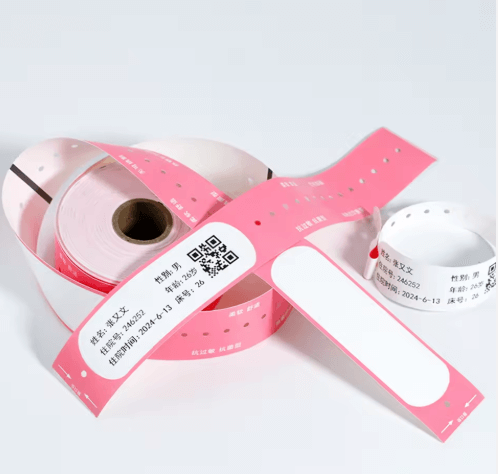
Patient identification remains one of the most critical risk control points in modern hospitals. In high-volume hospitals with emergency departments, ICUs, surgical centers, and inpatient wards operating simultaneously, manual or barcode-only identification methods often struggle under high throughput, staff rotation, and complex workflows. RFID Patient ID Wristbands have emerged as a technical solution designed to reduce misidentification, improve traceability, and support real-time data integration across hospital information systems.
Unlike traditional Patient ID Wristbands, RFID-enabled wristbands introduce contactless identification, automated data capture, and system-level verification. From an engineering perspective, their effectiveness depends not only on RFID chips, but also on material selection, antenna design, printing compatibility, and environmental durability. This article analyzes RFID Patient ID Wristbands from a materials and system engineering standpoint, with a focus on hospital deployment at scale.
Core Materials Used
RFID Patient ID Wristbands for hospital environments are typically engineered using multilayer composite structures. Each layer contributes to mechanical stability, patient comfort, and signal reliability.
The base substrate is commonly medical-grade synthetic materials such as Vinyl or coated polymer films. These materials provide flexibility while maintaining dimensional stability for embedded RFID inlays. For short-term admissions and emergency care, Tyvek Wristbands are also used due to their lightweight structure and tear resistance.
The RFID inlay consists of an ultra-thin aluminum or copper antenna bonded to a passive UHF or HF RFID chip. Antenna geometry is optimized to minimize detuning caused by proximity to the human body. A protective encapsulation layer isolates the inlay from moisture, disinfectants, and mechanical stress.
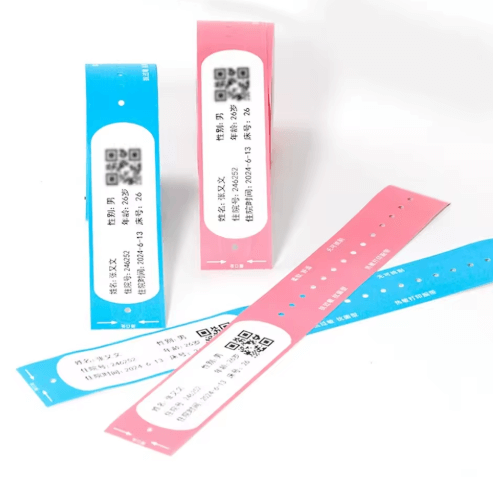
For patient-facing information, Thermal Printing Wristbands are widely adopted. Thermal coating layers must remain compatible with RFID inlays while ensuring print clarity for patient names, QR codes, and barcode redundancy. Medical-grade pressure-sensitive adhesives or ultrasonic sealing methods are used to ensure secure closure without causing skin irritation.
Material Performance Characteristics
From a hospital engineering standpoint, RFID Patient ID Wristbands must meet multiple performance requirements simultaneously.
Mechanical durability is critical for multi-day inpatient stays. The wristband must resist tearing, edge curling, and deformation during daily activities, bed transfers, and clinical procedures. Vinyl-based RFID wristbands typically outperform paper-based options in long-term wear scenarios.
Chemical resistance is another key factor. Hospital environments involve frequent exposure to alcohol wipes, chlorhexidine, and soap-based disinfectants. Waterproof and latex-free wristbands are preferred to prevent material degradation and allergic reactions.
RF signal stability is often overlooked but essential. Human tissue can absorb RF energy, especially in UHF bands. Material dielectric properties directly influence antenna efficiency. Engineers must balance flexibility and dielectric constant to maintain consistent read ranges at bedside readers, medication dispensing stations, and access control points.
Thermal printing compatibility affects operational efficiency. Print layers must maintain legibility after exposure to moisture and friction. Smearing or fading can compromise both human-readable and machine-readable identification, which is why hospital-grade RFID wristbands undergo abrasion and thermal aging tests.
fulida Case Study — Hospital Patient Identification Application
A tertiary-care hospital with over 1,200 beds faced recurring challenges in patient identification across its emergency and surgical departments. The existing barcode-based Patient ID Wristbands required line-of-sight scanning, leading to workflow delays during peak admission hours. Misreads caused by wristband damage and manual workarounds increased the risk of medication and specimen labeling errors.
From an engineering perspective, the hospital required a solution that could integrate with its HIS and LIS systems while maintaining patient comfort and infection control standards. fulida proposed a hospital-grade RFID Patient ID Wristbands solution using vinyl composite substrates with embedded HF RFID inlays.
The engineering challenge involved minimizing RF signal attenuation caused by body proximity while ensuring compatibility with existing thermal printers. fulida optimized antenna geometry using electromagnetic simulation and selected a low-dielectric encapsulation layer to stabilize read performance. The wristbands were validated for resistance to disinfectants and continuous wear over seven-day admission cycles.
After deployment, bedside RFID readers enabled automatic patient verification during medication administration and specimen collection. Engineering audits showed a measurable reduction in identification-related incidents and improved throughput in emergency admissions, supporting hospital-wide scalability.
Material Parameter Table
| Parameter | Specification |
|---|---|
| Base Material | Medical-grade Vinyl / Composite Polymer |
| RFID Type | Passive HF RFID (13.56 MHz) |
| Antenna Material | Aluminum Micro-Antenna |
| Wristband Thickness | 0.25–0.35 mm |
| Printing Method | Direct Thermal Printing |
| Water Resistance | Fully Waterproof |
| Chemical Resistance | Alcohol, disinfectant resistant |
| Skin Safety | Latex-free, biocompatible |
Application Scenarios Across Hospitals
In inpatient wards, RFID Patient ID Wristbands enable continuous patient verification during nursing rounds and medication delivery without direct scanning. In emergency departments, contactless identification reduces bottlenecks during triage and admission surges.
Operating rooms benefit from RFID-enabled tracking by linking patient identity to surgical schedules and instrument workflows. Laboratories leverage RFID wristbands to synchronize patient identity with specimen containers, reducing labeling errors in high-throughput diagnostic environments.
Across the hospital campus, integration with access control systems allows temporary authorization based on patient status, improving both safety and operational control.
Simulation and Verification
To ensure reliable performance, fulida applies engineering-level validation methods during wristband development. Electromagnetic simulations using HFSS are conducted to analyze antenna behavior near human tissue models. These simulations help optimize read range and orientation sensitivity.
ADS is used to model impedance matching between the RFID chip and antenna under varying dielectric conditions. Time Domain Reflectometry testing verifies antenna continuity and bonding integrity after mechanical stress testing.
Thermal FEM analysis evaluates material behavior under repeated thermal printing cycles and prolonged skin contact, ensuring dimensional stability and print layer adhesion throughout the wristband’s service life.
FAQ
How do RFID Patient ID Wristbands improve hospital workflows compared to barcodes
RFID enables contactless, automated identification without line-of-sight scanning, reducing manual handling and workflow interruptions.
Are RFID wristbands safe for continuous patient wear
Hospital-grade RFID wristbands are latex-free, biocompatible, and designed to meet medical skin-contact standards.
Can RFID Patient ID Wristbands work alongside barcodes
Yes, most hospital implementations use hybrid designs combining RFID with visible QR or barcode elements for redundancy.
What RFID frequency is most common in hospitals
HF RFID is widely used due to its stable performance near the human body and compatibility with short-range clinical workflows.
Why Choose Fulida
RFID Patient ID Wristbands represent a mature, engineering-driven solution for improving patient identification accuracy in high-volume hospitals. Through careful material selection, antenna optimization, and system-level validation, these wristbands support safer clinical workflows and scalable hospital operations. For healthcare engineering teams evaluating RFID wristband integration, understanding material performance and verification methods is essential for long-term success.