
Introduction
Hospital medical wristbands are a critical component of patient identification and clinical workflow management across Canadian healthcare facilities. From large provincial hospitals to outpatient clinics and diagnostic laboratories, Patient ID Wristbands serve as the first line of defense against misidentification, medication errors, specimen mix-ups, and access control failures. In Canada’s highly regulated healthcare environment, wristbands must meet stringent requirements for durability, print clarity, patient comfort, data accuracy, and compatibility with hospital information systems.
Core Materials Used in Hospital Medical Wristbands
Thermal Synthetic PP Wristbands
Thermal synthetic polypropylene (PP) wristbands are widely used in Canadian hospitals due to their balance of comfort, durability, and cost efficiency. These wristbands are optimized for direct thermal and thermal transfer printing, making them compatible with Zebra, SATO, Brady, and Honeywell printers commonly deployed in North America.
Key properties include water resistance, moderate chemical tolerance, and stable print adhesion for barcodes and alphanumeric data.
Vinyl Medical Wristbands
Vinyl wristbands are preferred in high-moisture and long-stay scenarios, such as emergency departments, intensive care units, and pediatric wards. Multi-layer vinyl structures allow encapsulation of printed inserts, ensuring long-term legibility even under repeated handwashing, disinfectant exposure, and patient movement.
Soft TPU / Silicone Wristbands
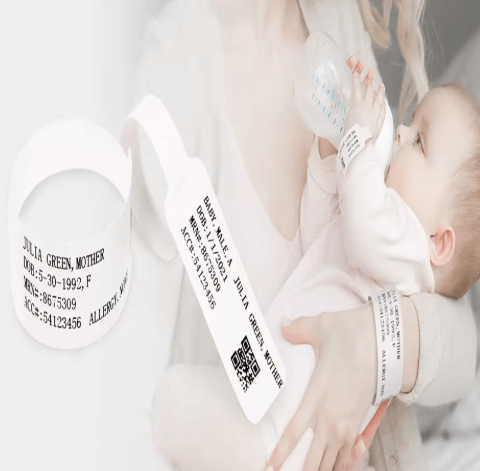
For neonatal care, long-term patients, and allergy-sensitive populations, TPU and medical-grade silicone wristbands provide enhanced skin compatibility and flexibility. These materials are latex-free, hypoallergenic, and suitable for extended wear without causing irritation.
RFID-Embedded Wristbands
RFID wristbands integrate HF (13.56 MHz) or UHF inlays into synthetic or vinyl substrates. In Canadian hospitals, RFID is increasingly adopted for patient tracking, infant security, asset linkage, and workflow automation, especially in large urban healthcare networks.
Material Performance Characteristics
Waterproof and Chemical Resistance
Hospital wristbands must remain readable after exposure to alcohol wipes, chlorhexidine, soaps, and saline solutions. Vinyl and laminated synthetic materials demonstrate superior resistance, verified through accelerated chemical immersion testing.
Print Stability and Barcode Accuracy
High barcode contrast and edge definition are essential for accurate scanning at medication dispensing points and laboratory stations. fulida wristbands are validated using barcode grading (ANSI/ISO) and printhead compatibility testing to ensure stable output across thermal printers.
Tear Resistance and Security
Tamper-evident adhesive closures and destructible locking mechanisms are used to prevent wristband transfer between patients. Mechanical tensile testing confirms controlled breakage under forced removal.
Patient Comfort and Biocompatibility
Materials comply with latex-free and skin-contact safety requirements. Surface smoothness and rounded edges reduce pressure points, which is critical for elderly and pediatric patients.
fulida Case Study – Canadian General Hospital Network
Client Background
A multi-site general hospital network in Ontario required a unified patient identification wristband system across emergency, inpatient, and laboratory departments. The existing solution suffered from barcode fading, adhesive failure, and incompatibility with newer thermal printers.
Engineering Challenges
- Frequent barcode scanning failures after 48–72 hours
- Wristband delamination under alcohol-based disinfectants
- Inconsistent sizing for adult and pediatric patients
- Limited support for future RFID integration
fulida Engineering Solution
fulida deployed a multi-layer waterproof vinyl wristband with high-contrast thermal transfer printing. Material stack-up and adhesive chemistry were optimized using thermal FEM simulation and peel-force validation. RFID-ready variants were introduced for phased system upgrades.
Results
- Barcode scan success rate increased to >99.8%
- Wristband lifespan extended beyond 7 days in inpatient use
- Reduced reprint and nursing intervention rates
- Seamless compatibility with existing Zebra printer infrastructure
Material Parameter Table
| Parameter | Synthetic PP | Vinyl | TPU / Silicone | RFID Variant |
|---|---|---|---|---|
| Waterproof | Good | Excellent | Excellent | Excellent |
| Chemical Resistance | Medium | High | High | High |
| Print Method | DT / TT | Insert / TT | Laser / Engrave | TT / Encoded |
| Wear Duration | Short–Medium | Medium–Long | Long | Medium–Long |
| Patient Comfort | Good | Good | Excellent | Good |
Application Scenarios in Canada
Acute Care Hospitals
Used for patient identification, medication administration, and access control in emergency and inpatient units.
Clinics and Outpatient Centers
Lightweight thermal wristbands support high patient turnover and rapid printing at registration desks.
Diagnostic Laboratories
Barcode wristbands ensure accurate specimen-patient matching across blood, pathology, and biopharmaceutical testing workflows.
Pediatric and Neonatal Units
Soft, latex-free materials reduce skin irritation while maintaining secure identification.
Frequently Asked Questions (FAQ)
Q1: Are these wristbands compatible with Canadian hospital printers?
Yes. fulida wristbands are tested with mainstream thermal printers used across Canada.
Q2: Do the materials comply with latex-free requirements?
All medical wristbands are manufactured using latex-free materials suitable for sensitive patients.
Q3: Can barcodes and QR codes be combined?
Yes. Multi-code layouts are supported for HIS, LIS, and EMR integration.
Q4: Is RFID mandatory for Canadian hospitals?
RFID is not mandatory but increasingly adopted for patient safety and operational efficiency.
Why Choose Fulida
Fulida specializes in engineered identification solutions for healthcare environments. With deep expertise in material science, thermal printing optimization, and system compatibility, Fulida delivers hospital medical wristbands that meet Canadian clinical demands while supporting scalability and future digital integration.