
Introduction
Maintaining specimen integrity is a fundamental requirement in modern clinical laboratories, where diagnostic accuracy depends heavily on strict environmental control during collection, storage, and transportation. Biological samples such as blood, urine, tissue, and reagent kits are highly sensitive to moisture intrusion, condensation, and accidental liquid exposure. Even brief contact with water can compromise analyte stability, introduce contamination, or invalidate test results.
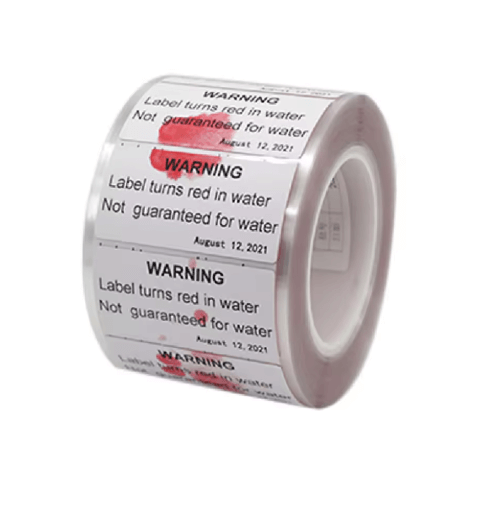
Traditional laboratory protocols rely on secondary packaging, absorbent materials, and procedural audits to control moisture risks. However, these methods lack a direct visual indicator that confirms whether a sample or package has been exposed to water during handling. This gap has driven growing adoption of custom water sensitive stickers as a low-cost, passive monitoring solution that provides immediate, irreversible evidence of moisture exposure.
In North American laboratory environments—where compliance with CLIA, CAP, and ISO 15189 standards is critical—water sensitive stickers are increasingly integrated into specimen transport kits, cold-chain packaging, and diagnostic consumables. Their ability to visually signal moisture events supports quality control, traceability, and risk mitigation without altering existing workflows.
Core Materials Used
Custom water sensitive stickers are engineered using multilayer material systems designed to react rapidly and reliably to moisture while maintaining compatibility with laboratory environments.
The primary functional layer is a water-reactive coating, typically based on specially formulated dyes or pigments that undergo a permanent color change when exposed to water or high humidity. This layer is calibrated to respond to liquid contact rather than ambient humidity, minimizing false positives in refrigerated or controlled environments.
The substrate layer is commonly produced from PET film or high-grade coated paper. PET substrates are preferred in clinical laboratories due to their dimensional stability, resistance to tearing, and compatibility with low-temperature storage. The substrate also serves as a barrier to prevent moisture migration beyond the reactive layer, ensuring localized and accurate indication.
An industrial-grade pressure-sensitive adhesive completes the structure. For laboratory use, adhesives are selected to maintain adhesion on plastic specimen bags, polypropylene tubes, glass vials, and secondary packaging materials without leaving residue. Adhesive formulations are designed to remain stable under refrigerated and frozen conditions, supporting cold-chain applications.
Material Performance Characteristics
The effectiveness of water sensitive stickers in clinical laboratories depends on predictable and repeatable material performance. Key characteristics include response sensitivity, permanence, environmental stability, and visual clarity.
Response sensitivity is precisely tuned so that the indicator activates upon direct water contact or condensation droplets, rather than gradual humidity changes. This distinction is critical in laboratory cold rooms, where high relative humidity may be present without actual sample compromise.
Once activated, the color change is irreversible, providing a tamper-evident record of exposure. This permanence supports audit trails and allows laboratory staff to quickly identify compromised specimens without subjective interpretation.
Temperature resistance is another essential factor. Water sensitive stickers used in laboratories must perform reliably across a wide temperature range, typically from frozen storage to room-temperature handling. High-quality formulations maintain responsiveness after prolonged cold exposure, ensuring accurate indication during transport from collection sites to testing facilities.
Visual contrast and legibility are optimized for fast inspection. Clear color transitions allow technicians to assess sample status at a glance, reducing handling time and minimizing workflow disruption.
fulida Case Study — Clinical Laboratory Application
A regional clinical diagnostics laboratory network in North America processes thousands of blood and urine specimens daily across multiple collection sites. The laboratory experienced recurring challenges with sample rejection due to suspected moisture exposure during refrigerated transport, particularly in winter months when condensation formed inside insulated transport containers.
The client required a solution that could provide objective, visible evidence of moisture exposure without increasing packaging complexity or cost. Existing temperature loggers and absorbent materials did not indicate whether individual specimen bags had been directly exposed to water.
Fulida collaborated with the laboratory’s quality assurance team to implement custom water sensitive stickers integrated into specimen transport bags. The stickers were positioned near closure seams and high-risk condensation zones. Material selection focused on PET-based substrates with cold-resistant adhesives to ensure adhesion during refrigerated transport.
After deployment, the laboratory reported a measurable reduction in disputed sample integrity cases. Technicians could immediately identify compromised specimens upon receipt, enabling faster rejection decisions and reducing unnecessary retesting. The visual indicators also supported internal audits and helped demonstrate compliance during CAP inspections.
Material Parameter Table
| Parameter | Specification |
|---|---|
| Substrate Material | PET film or coated paper |
| Reactive Layer | Water-activated dye coating |
| Adhesive Type | Pressure-sensitive, cold-resistant |
| Activation Method | Direct water or condensation contact |
| Color Change | Irreversible, high-contrast |
| Operating Temperature | Frozen to ambient laboratory conditions |
| Shelf Life | 12–24 months under dry storage |
| Customization | Size, shape, color pattern, branding |
Application Scenarios Across Clinical Laboratories
In clinical laboratories, water sensitive stickers are widely used in specimen transport kits to monitor moisture exposure during courier handling. They are also applied to secondary packaging for diagnostic reagents, ensuring integrity during cold-chain storage.
Microbiology laboratories use water sensitive stickers on culture plates and swab transport containers to detect leakage or condensation that could compromise results. In pathology departments, they are applied to tissue sample containers to verify that fixation fluids have not leaked during transit.
Beyond core laboratory settings, these indicators are increasingly adopted by biopharmaceutical companies and contract research laboratories involved in clinical trials, where sample integrity documentation is critical for regulatory submissions.
FAQ
Do water sensitive stickers activate in high-humidity laboratory environments?
High-quality water sensitive stickers are designed to respond to direct water contact rather than ambient humidity, reducing false activation in controlled laboratory conditions.
Are these stickers compatible with refrigerated and frozen storage?
Yes. Laboratory-grade formulations maintain adhesion and responsiveness across cold-chain temperature ranges.
Can stickers be customized for laboratory branding or instructions?
Custom printing options allow integration of logos, instructions, or batch codes without affecting indicator performance.
Do activated stickers affect sample safety?
No. The reactive coating is external and does not come into contact with the specimen or container contents.
Why Choose Fulida
Fulida specializes in engineering-grade custom water sensitive stickers for regulated laboratory and healthcare environments. Our material selection process prioritizes performance consistency, cold-chain compatibility, and compliance with North American laboratory standards.
With in-house customization capabilities, Fulida supports laboratory procurement teams with tailored sizes, activation thresholds, and adhesive systems optimized for real-world clinical workflows. Our experience across clinical laboratories, diagnostics, and biopharmaceutical applications enables us to deliver solutions that improve quality control while supporting efficient, scalable operations.
For laboratories seeking reliable, visible moisture monitoring without complex electronics, Fulida provides a practical and proven labeling solution aligned with modern sample integrity requirements.